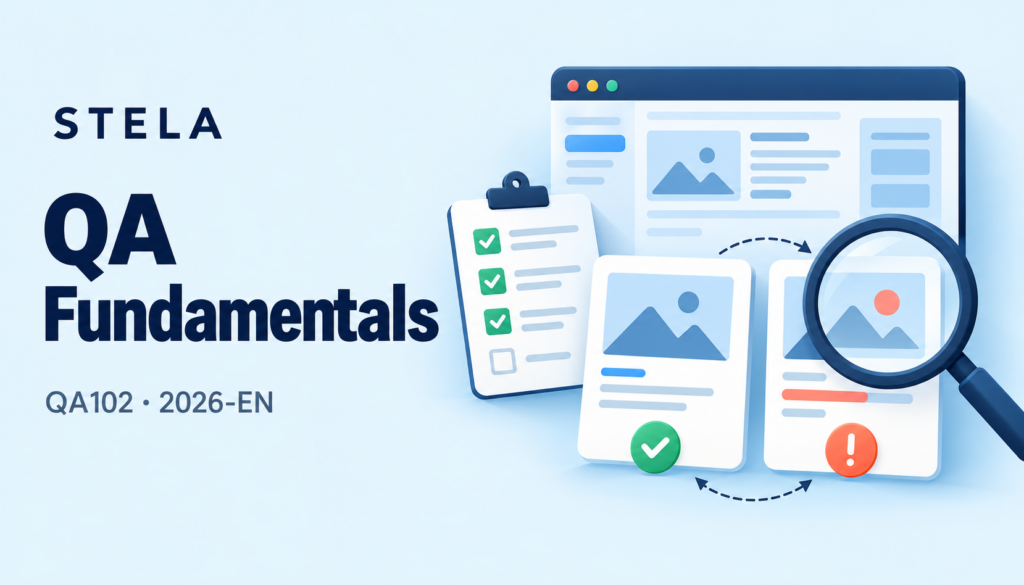
STELA QA Fundamentals takes you from a designed test case to a suite you can run, repeat, and explain. Work with the catalog and cart of STELA STORE to connect each business rule with an action, an observable response, an explicit comparison, and evidence of the result. You will learn the STELA workspace from the beginning without needing programming knowledge.
Build your first tests using object recognition, Robot Maker, and Computer Vision. Review generated proposals, confirm that you are acting on the correct object, and choose waits that support the check you need to perform. Practice both successful operations and expected rejections while keeping the expected result independent from the system’s output.
As your suite grows, introduce variables, spreadsheet data, and additional cases. Prepare a known starting state, prevent data from carrying over between cases, and organize shared steps with clear responsibilities. You will also investigate failures, distinguish evidence from hypotheses, and write reports that help another person understand the next step.
The final project brings these skills together in a verifiable suite with execution evidence, an individual explanation, and a new variant. A fillable workbook and reference guide support the practical work. This course builds on the test-design competencies taught in STELA – Introduction to Test Automation and requires access to the assigned STELA and STORE practice environment.
– Getting started: prepare your workbook, reference materials, practice environment, and execution evidence.
– From test design to STELA: translate requirements into cases with independent preparation and explicit expected results.
– Your first test: recognize objects, review Robot Maker proposals, use Computer Vision, define waits, and compare outcomes.
– Data and initial coverage: use variables and spreadsheet rows while preserving each case’s data and meaning.
– Repeatability: restore a known state, vary execution order, and retain the history of every attempt.
– Organization and reuse: share steps, organize data sets, and assess the impact of a change.
– Failure diagnosis: investigate evidence, distinguish causes from hypotheses, and communicate blocked or failed checks.
– Final project: build, execute, and explain a repeatable suite with reviewable evidence and an individual variant.