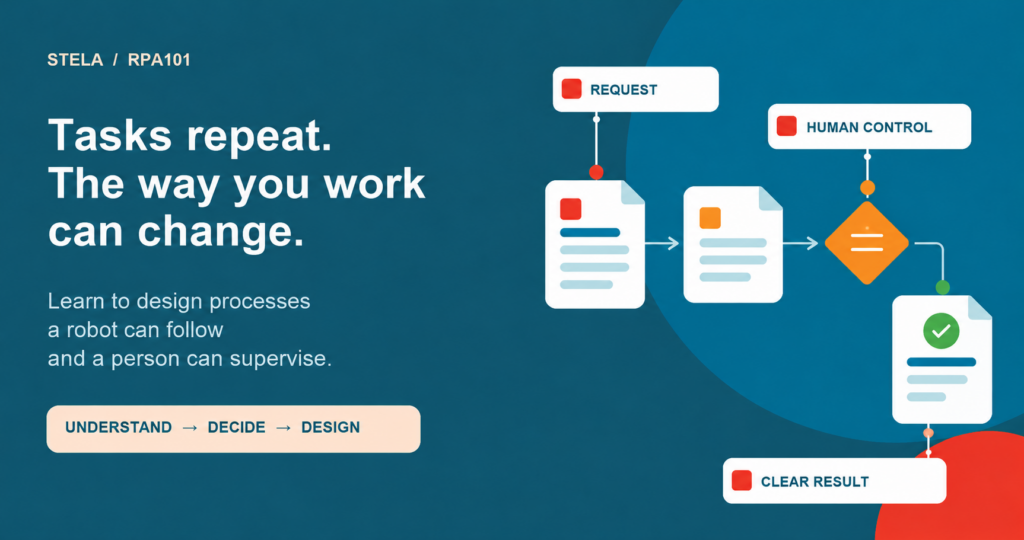
This introduction to RPA teaches you how to turn a recurring business task into a procedure that a robot can follow and a person can supervise. Learn what robotic process automation can contribute, how to choose a suitable process, and how to define a result that can be checked. The focus is on clear business rules and sound process design.
Follow Ana from Purchasing through a fictional material-request scenario. You will work with incomplete information, pending authorizations, alternative paths, and results that need verification. Map the workflow using a diagram or numbered steps, identify the required data, and assign responsibility for decisions that require human judgment.
The course introduces checks before acting, after important stages, and before closing a request. Learn how to handle exceptions, preserve evidence, and specify when work may resume. You will also review simulated AI proposals and distinguish assistance with interpretation from authority to approve an action. Examples, workbook activities, and questions with feedback support each stage of your design.
In the final workshop, present a complete purchasing procedure and control matrix, explain how it handles the workshop situations, and defend your decisions in individual review. No programming knowledge, RPA experience, STELA installation, or STORE account is required. This course prepares you for STELA – RPA Fundamentals, where you begin implementing and testing robots in the practice environment.
– Getting started: prepare your workbook, use the purchasing case references, and understand the final design assignment.
– What RPA is and where it helps: connect repeated tasks with business rules and verifiable results.
– Choosing a process: assess data, rules, stability, scope, and the consequences of errors.
– Mapping the complete process: describe inputs, steps, decisions, alternative paths, and responsible people.
– Controls, exceptions, and AI: define checks, preserve evidence, review AI proposals, and specify human intervention and resumption.
– Final workshop: design a purchasing procedure and control matrix, address eight situations, and explain your decisions.